
Generative AI and NZ Local Government
Local government in New Zealand is operating in an environment of sustained structural pressure. Rates constraints, infrastructure backlogs, regulatory complexity, and rising public expectations are converging at the same time. Councils are not short of commitment or professional expertise. What they are short of is time and organisational capacity.
In that context, the way administrative systems operate matters.
Generative AI refers to tools that can retrieve digital records, generate draft reports, summarise submissions, and analyse patterns across planning, compliance, and operational data. It is not a substitute for political decision-making or community engagement, and it will not solve structural funding issues. Its potential lies in easing the administrative workload that sits beneath many core council functions.
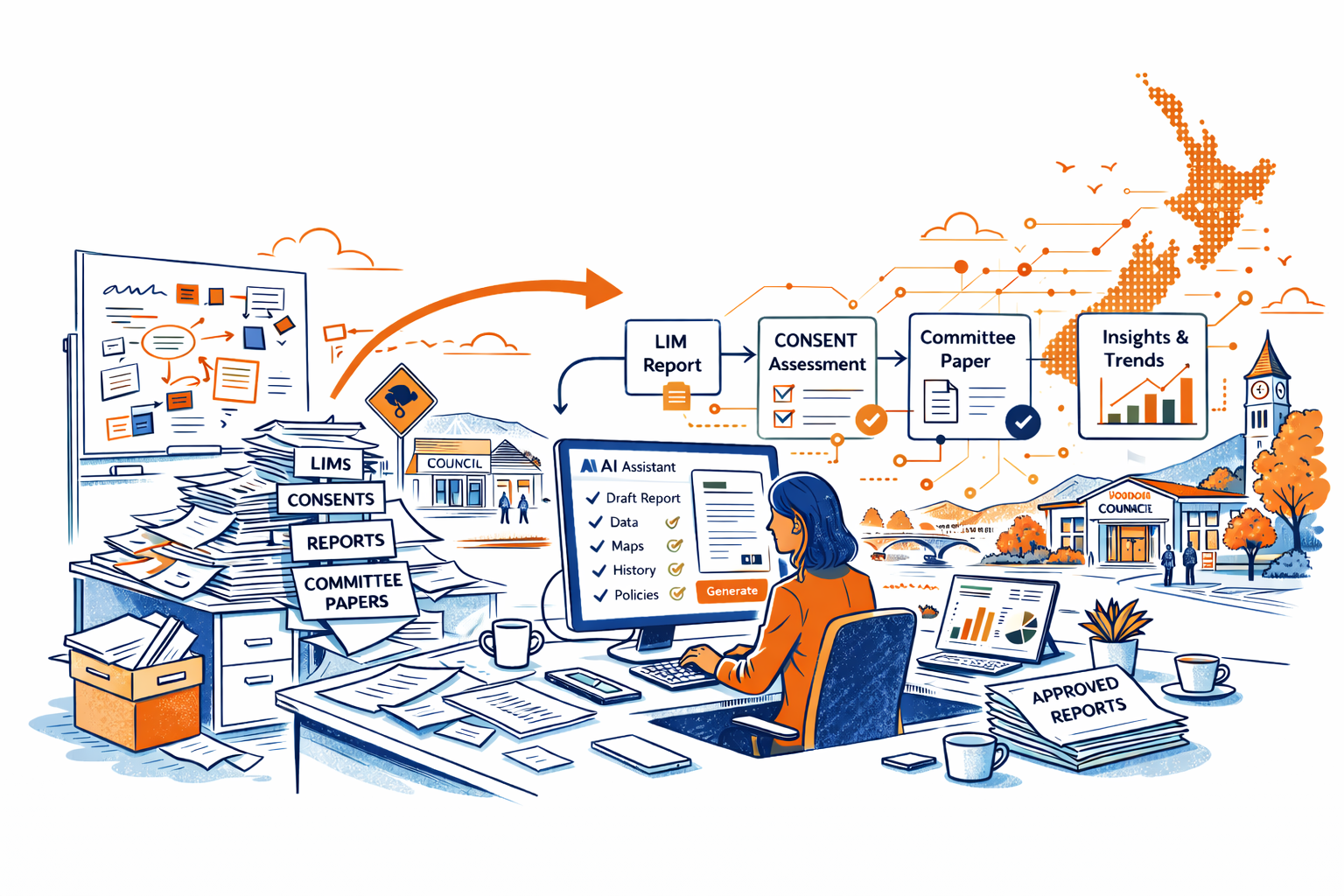
Much of local government work is structured, repeatable, and template-driven. This is not a flaw. It is the natural consequence of operating within statutory and governance frameworks. Land Information Memorandums, resource consent reports, committee papers, Long Term Plan updates, and customer service workflows all rely on defined formats and precedent material.
Yet a considerable proportion of professional time is still spent locating, assembling, cross-referencing, and formatting information that already exists in digital systems. When highly trained planners, engineers, and policy advisers are spending significant time drafting and assembling reports rather than analysing issues and engaging with communities, something is out of balance.
Generative AI is well suited to this layer of work. Not as a decision-maker. Not as a replacement for statutory accountability. Rather, as a drafting and synthesis tool operating within clearly defined governance parameters and subject to human oversight.
If repetitive report drafting can be reduced, professional capacity can be redirected to where it is needed most.
Land Information Memorandums
LIM processes draw from property files, zoning overlays, hazards registers, and infrastructure datasets. In most councils, this information is already digitised, although often stored across multiple systems.
AI tools could retrieve relevant datasets, identify inconsistencies, and generate draft LIM reports using council-approved templates. Staff would continue to verify accuracy and exercise judgement, and accountability remains with the council.
The benefit is improved consistency and timeliness. Faster LIM turnaround improves service delivery, reduces frustration for applicants, and provides greater certainty in property transactions. When the information already exists in structured form, manual collation should not be the default setting.
Resource Consents and System Learning
Resource consent processes are defined in the Resource Management Act and must take into account national direction and Regional and District Plan provisions. Officer reports apply statutory tests and follow established formats. Drafting these reports is often time-consuming, even where the environmental effects of development activity are well understood.
AI tools can assist by generating structured first drafts, cross-referencing relevant plan provisions, and identifying comparable previous decisions. This reduces drafting time while leaving substantive analysis and judgement with the planner.
The more significant opportunity lies beyond drafting efficiency.
If planners spend less time assembling reports, they can devote more time to site visits, contextual assessment, and meaningful engagement with applicants and affected parties. Community consultation, risk analysis, scenario testing, and strategic advice are where professional expertise adds the greatest value.
At a system level, AI can analyse patterns across resource consent activity, identifying which rules most frequently trigger applications, such as height or setback provisions. Those patterns can inform a structured review of whether current rules continue to deliver their intended outcomes. In this way, AI supports ongoing policy refinement rather than simply faster report drafting.
Governance and Corporate Reporting
Committee reports, risk registers, performance dashboards, and Long Term Plan updates follow consistent structures. Despite this, much of the underlying material is recreated in each reporting cycle.
AI can assist by drafting structured reports from data inputs, maintaining formatting consistency, and identifying areas where performance trends warrant closer attention. This does not remove the need for staff judgement. Instead of reconstructing recurring material, staff can focus on community consultation, risk analysis, scenario testing, and strategic advice. Governance quality improves when attention is directed toward interpretation and options rather than document assembly.
Operational Systems
Beyond documentation, generative AI has practical applications in operational management. Maintenance schedules for parks and reserves can respond dynamically to seasonal growth patterns and usage data. Infrastructure inspection cycles can move toward predictive models rather than reactive responses. Customer service requests can be categorised and prioritised more effectively.
These improvements do not displace operational teams. They strengthen planning and resource allocation. In a constrained fiscal environment, incremental efficiency gains are cumulative.
Shared Capability Across the Sector
New Zealand has 67 territorial authorities. At present, each council largely procures and configures its own digital systems. While local context matters, the administrative tasks underpinning LIMs, resource consent drafting, and governance reporting are fundamentally similar across the country.
There is limited strategic value in developing 67 separate AI-enabled drafting tools to solve essentially the same problem. Shared modules, developed once and configured locally, would reduce cost and allow collective learning across the sector.
If AI adoption is fragmented and bespoke, gains will be modest. If it is coordinated and standards-based, gains will be more substantial and sustainable.
Workforce and Governance
Concerns about workforce implications are understandable. In practice, most councils are experiencing capability strain rather than surplus staffing. Planning, engineering, and policy roles are difficult to recruit, and retention remains an ongoing challenge.
AI should be understood as an administrative support tool that reduces repetitive tasks and strengthens analytical capacity. Professional judgement, statutory interpretation, and democratic accountability remain human responsibilities.
Adoption must also be governed carefully. Data security, privacy, transparency, auditability, and human oversight are essential. The New Zealand Public Service Artificial Intelligence Framework provides a clear set of principles around governance, safety, and accountability. Councils should align with these principles deliberately and early.
A Practical Reform Opportunity
Generative AI will become embedded in administrative systems across the wider economy. The relevant question for local government is not whether it will engage with these tools, but how, and to what end.
If used deliberately, AI can reduce repetitive drafting, strengthen institutional learning, and enable better allocation of professional time. It can support planners to spend more time on site visits and community engagement. It can assist policy teams to interrogate patterns in consent activity and regulatory settings, and enable governance staff to focus on risk, options, and performance rather than drafting and formatting papers.
Local government is under sustained pressure. Where administrative effort does not add public value, it should be reconsidered.
Key Takeaways
Generative AI should be positioned as an administrative support tool, not a decision-maker.
The greatest value lies in sourcing information, reducing repetitive drafting, and enabling system-level analysis.
Shared AI capability across New Zealand’s 67 territorial authorities would deliver greater value than fragmented, bespoke experimentation.
Governance, privacy, transparency, and human oversight must remain central to adoption.
The objective is not workforce reduction, but better use of professional expertise.